
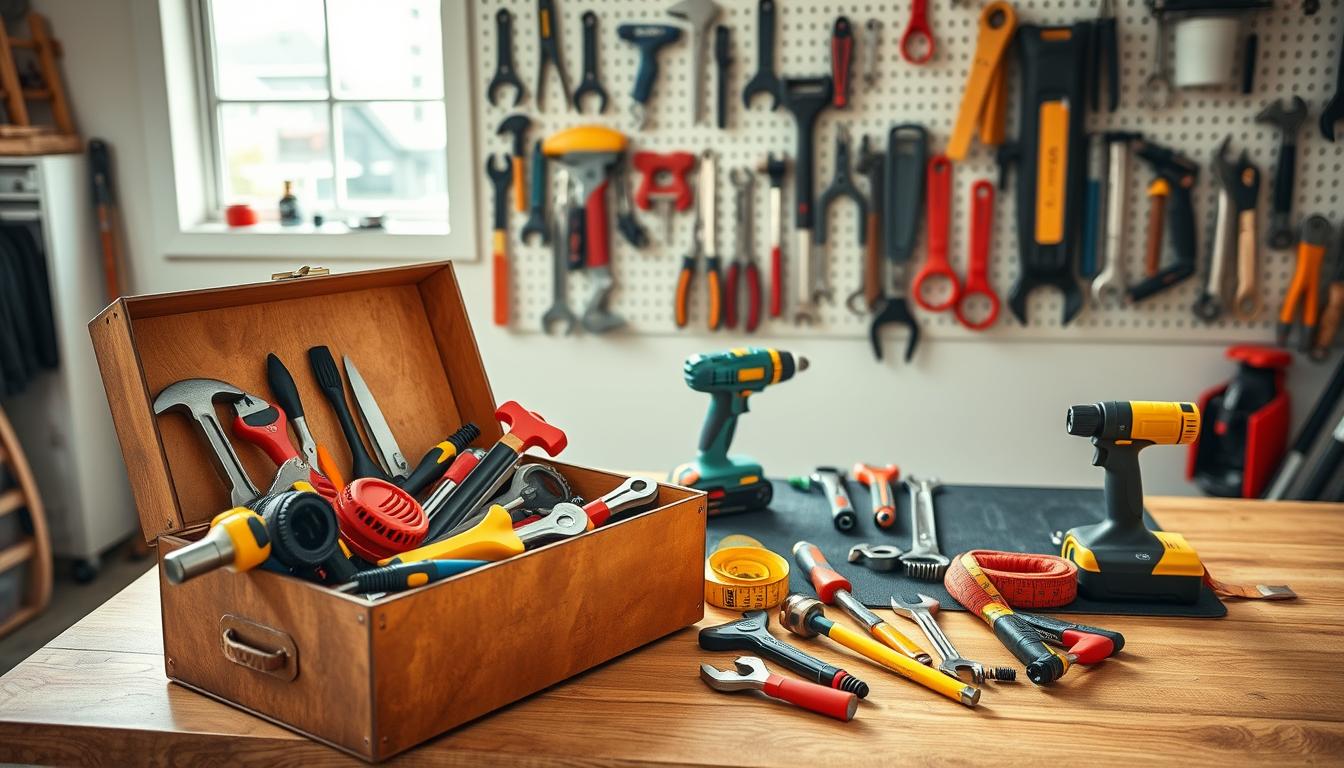
Owning a property brings many maintenance tasks and repair challenges. Having the right equipment ready makes these jobs much easier. A well-stocked workshop helps you handle common issues without calling professionals.
Building a comprehensive toolkit is a smart investment for property maintenance. The right equipment can turn a frustrating project into a quick fix. It saves both time and money in the long run.
Knowing which items are truly essential helps you prioritize purchases. This prevents wasting money on equipment that rarely gets used. Our guide covers fundamental items from basic hand tools to essential power equipment.
Whether you’re new to property ownership or upgrading your existing collection, this information prepares you for common household projects. Having proper equipment on hand provides peace of mind. You can tackle unexpected problems quickly without extra expense.
Key Takeaways
- Proper equipment makes home maintenance tasks easier and more efficient
- A well-stocked toolkit saves money by reducing professional service calls
- Quality tools transform frustrating projects into quick fixes
- Focusing on essential items prevents wasteful spending on unused equipment
- Being prepared with the right tools provides confidence for unexpected repairs
- This guide covers both basic hand tools and essential power equipment
- Proper preparation helps handle common household projects independently
Introduction to Homeowner Tools
Managing a residence involves ongoing upkeep responsibilities that require proper equipment. From simple fixes to more complex projects, having the right gear transforms how you approach household challenges.
An Overview of DIY Projects and Home Repairs
Common household tasks range from furniture assembly to basic plumbing repairs. Picture hanging, shelf installation, and minor electrical work frequently arise. Yard maintenance also demands attention throughout the seasons.
These activities become manageable with appropriate implements. Addressing issues promptly prevents them from escalating into costly problems. Quick action saves both time and money in the long run.
Setting the Stage for a Well-equipped Home
Building a functional toolkit begins with understanding typical home needs. Start with fundamental items that serve multiple purposes. This strategic approach ensures your investment gets regular use.
A well-prepared residence provides confidence for handling both routine maintenance and unexpected situations. You gain independence from calling professionals for minor issues. This self-reliance develops over time as skills improve.
Understanding the Importance of Quality Tools
The foundation of successful home maintenance lies in selecting equipment that delivers reliable performance over time. Superior craftsmanship in your workshop gear makes a noticeable difference in project outcomes.
Well-made implements transform difficult tasks into manageable activities. They provide consistency that budget options often lack.
Long-Term Savings and Durability
Investing in high-quality equipment saves money over years of use. Durable construction means fewer replacements and consistent performance.
Metal components withstand regular use far better than plastic alternatives. This durability ensures your investment continues paying dividends long after purchase.
Safety and Performance Benefits
Properly designed equipment significantly enhances user safety. Balanced construction and secure grips prevent accidents during operation.
Superior performance means completing projects correctly the first time. This efficiency saves both time and frustration on household tasks.
Comfortable, well-engineered gear reduces strain during extended work sessions. The right equipment makes maintenance activities more enjoyable and productive.
Selecting the Right Tools for Your Skill Level
The journey to a well-equipped home begins with honest self-assessment of your DIY capabilities. Tom Silva from This Old House emphasizes understanding the user’s experience level before choosing any tool.
Matching equipment to your abilities prevents frustration and ensures regular use. This approach creates positive experiences that encourage skill development over time.
Beginner-Friendly Options
New DIY enthusiasts benefit from basic, intuitive equipment that forgives minor mistakes. Simple designs with clear instructions build confidence gradually.
Start with multi-purpose items that handle common household projects. These foundational pieces provide immediate value while developing fundamental skills.
Advanced Tools for Experienced DIYers
Seasoned practitioners can leverage specialized equipment with enhanced precision features. These items tackle complex challenges efficiently.
Advanced capabilities support ambitious projects requiring greater accuracy. The investment pays dividends through professional-quality results.
| Consideration | Beginner Focus | Advanced Focus |
|---|---|---|
| Learning Curve | Simple operation | Specialized features |
| Common Tasks | Basic repairs | Complex projects |
| Investment Priority | Versatile basics | Precision equipment |
| Skill Development | Foundation building | Technique refinement |
Essential Power Tools for Home Projects
Electric-powered equipment transforms how you approach household tasks. These devices handle demanding jobs with speed and precision.
Investing in quality equipment makes complex projects manageable. The right selection saves time and effort on various activities.
Drill/Driver and Its Versatility
A cordless drill stands as the most versatile power tool for residential needs. This device handles both hole drilling and screw driving functions.
Look for models with rechargeable batteries for maximum mobility. Freedom from cords makes work more efficient throughout your space.
The right drill becomes indispensable for assembly, repair, and installation projects. Its dual functionality eliminates the need for separate devices.
Other Must-Have Power Tools
Beyond the basic drill, several other power tools prove valuable for comprehensive home maintenance. Each serves specific purposes that manual alternatives cannot match.
Consider battery systems that work across multiple devices. This approach reduces overall costs and storage requirements.
| Tool Type | Primary Function | Common Applications |
|---|---|---|
| Circular Saw | Straight cuts | Lumber cutting, shelving |
| Jigsaw | Curved cuts | Custom shapes, openings |
| Orbital Sander | Surface smoothing | Wood finishing, prep work |
| Reciprocating Saw | Demolition work | Pipe cutting, removal |
Major brands like DeWalt and Milwaukee offer combo set options. These packages provide multiple devices sharing battery systems.
Starting with a compatible drill allows future expansion. This strategy builds your collection efficiently over time.
Hand Tools That Every Homeowner Needs
The most reliable workshop investments often come from fundamental hand implements. These manual devices handle countless tasks from minor adjustments to significant installations.
Quality manual equipment provides precision that power alternatives sometimes lack. They form the backbone of any well-prepared workshop.
Screwdrivers, Tape Measures, and Levels
A comprehensive screwdriver collection covers various fastener types and sizes. Include small precision screwdrivers for delicate electronic work.
Consider a multibit screwdriver with interchangeable heads for maximum versatility. This approach reduces clutter while maintaining capability.
For measuring tasks, a quality tape measure proves indispensable. Select one extending at least 16 feet for residential applications.
The tape should feature clear markings and a durable case. Accurate measurements prevent costly installation errors.
A reliable level ensures straight installations for shelves and artwork. Invest in a quality torpedo level rather than budget options.
Utility Knives and Pliers Essentials
A sharp utility knife handles diverse cutting needs from packaging to drywall. Models with replaceable blades offer long-term value.
Pliers provide gripping and cutting capabilities for various materials. A basic set might include slip-joint and combination types.
Specialized options like needle-nose pliers reach confined spaces effectively. These precision tools complete tasks where fingers cannot reach.
Each manual device serves specific purposes within your workshop. Together they create a foundation for successful projects.
tools every homeowner should have
A thoughtfully assembled workshop addresses the majority of household maintenance situations efficiently. Strategic selection prevents wasted spending on rarely used items while ensuring readiness for common tasks.
Compiling a Comprehensive Toolkit
Building a versatile collection requires understanding which implements handle frequent residential needs. This approach creates a foundation capable of addressing diverse situations without unnecessary duplication.
The right selection reflects your property’s specific characteristics and your maintenance preferences. Consider the age of your home and typical repair requirements when planning acquisitions.
Systematic development over time spreads out financial investment while prioritizing immediate necessities. Start with multi-purpose items that serve multiple functions across different scenarios.
Proper organization in dedicated storage protects your investment and ensures quick access. A well-maintained collection provides reliable service for decades, making quality choices worthwhile.
This reference serves both new property owners building from scratch and experienced individuals filling gaps. The confidence gained from successful DIY work encourages tackling more complex challenges over time.
Basic Plumbing and Repair Tools
When water-related problems occur, having fundamental plumbing implements ready prevents minor issues from escalating. Even without professional expertise, basic equipment empowers you to address common situations confidently.
Richard Trethewey from This Old House emphasizes the importance of proper preparation. “Having the right gear for plumbing work saves time and prevents damage,” he notes.
Wrenches and Plumber’s Pliers for Repairs
Wrenches are essential for many plumbing tasks. They tighten or loosen nuts and bolts on pipes and fixtures. An adjustable wrench provides versatility for various repairs.
You’ll need either multiple adjustable wrenches or a set of fixed wrenches. This ensures you have the correct size for any task.
Plumber’s pliers feature jaws set at an angle to the handle. This design allows better leverage in confined spaces. They grip pipe connections where standard pliers struggle.
Plungers for Emergency Clogs
A quality plunger handles minor drain blockages before they become serious. Choose one with a flange for toilet use. Standard plungers work best on flat surfaces like sinks.
Having this variety of basic equipment enables you to handle common plumbing situations independently. Quick response prevents water damage and costly professional calls.
| Tool Type | Primary Function | Best Applications |
|---|---|---|
| Adjustable Wrench | Nut and bolt adjustment | Faucet repairs, pipe connections |
| Plumber’s Pliers | Pipe gripping and turning | Tight spaces, angled connections |
| Flange Plunger | Drain unclogging | Toilet blockages, effective seal |
| Standard Plunger | Surface clearing | Kitchen sinks, flat drain openings |
Mounting and Fastening Tools for Secure Installations
Mounting items securely to your wall requires understanding proper fastening techniques. Basic hardware works for lightweight objects like picture frames. Heavier items demand upgraded mounting solutions for safety and durability.
Direct attachment to wall studs provides maximum security for brackets and heavy fixtures. Stud placement doesn’t always align with your desired mounting position. Modern construction often uses metal studs instead of wood, limiting direct attachment options.
Stud Finders and Wall Anchors
A quality stud finder becomes essential for locating solid framing behind drywall. This device helps determine whether stud mounting is possible. When studs aren’t available, various anchor systems provide reliable alternatives.
Different anchor types suit specific weight requirements and wall conditions. Understanding available options ensures you select appropriate hardware. Proper selection prevents damage to your wall and ensures long-term security.
Using E-Z Anchors and Toggle Bolts
E-Z Anchors offer excellent holding power for medium-weight applications. These plastic anchors expand when screws are inserted, creating a secure grip. They work with just a screwdriver and suit various sizes of installations.
For heavier loads, upgraded versions handle up to 75 pounds. Metal E-Z Anchors tackle hard wallboard or wooden stud situations. Both options require specific drill holes for proper installation.
Toggle bolts provide extreme strength for televisions, shelves, and bike racks. These heavy-duty bolts expand behind the wall for maximum support. The trade-off involves larger installation holes compared to other options.
Professional builders understand that selecting the right fasteners is as important as choosing proper equipment. Matching hardware to your specific needs ensures successful installations that withstand daily use.
Outdoor and Landscaping Tools for Home Maintenance
Outdoor spaces demand specialized equipment designed for nature’s elements. Proper landscape maintenance protects your investment and enhances your home‘s curb appeal. The right implements transform challenging yard work into manageable tasks.
Landscape expert Jenn Nawada emphasizes that a quality pair of pruners proves essential for plant health. “Heavy-duty pruners should handle both delicate perennials and woody shrubs,” she advises. This versatility supports various pruning needs throughout the seasons.
Beyond pruning, several other implements complete essential yard work. A reliable garden hose ensures proper hydration for your plants. A sturdy lawn mower maintains grass at optimal height for health and appearance.
For larger home landscapes, additional equipment becomes necessary. A durable rake gathers leaves and debris efficiently. A strong shovel handles digging, planting, and soil amendment projects.
Make sure your outdoor equipment matches your property’s specific requirements. Consider yard size, plant varieties, and seasonal needs when selecting implements. Proper tool selection ensures efficient completion of landscaping tasks.
| Tool Type | Primary Function | Best For Properties |
|---|---|---|
| Heavy-Duty Pruners | Plant trimming | Gardens with shrubs and perennials |
| Lawn Mower | Grass cutting | Homes with lawn areas |
| Garden Rake | Debris collection | Yards with trees and gardens |
| Digging Shovel | Soil work | Landscapes requiring planting |
The Role of Multitools in Everyday Repairs
Compact multitools revolutionize how we approach spontaneous household fixes by combining essential functions in one portable package. These all-in-one devices eliminate the need to search through a full toolbox for minor adjustments.
Richard Trethewey from This Old House emphasizes their value, stating he carries a multitool constantly for unexpected situations. This endorsement highlights their practical utility in residential maintenance.
Portable, Versatile, and Convenient
The primary advantage lies in their compact design. Multitools fit easily in pockets, glove compartments, or kitchen drawers for immediate access.
Most models include pliers, knives, screwdrivers, and other essential implements. This consolidation handles a surprising variety of everyday tasks efficiently.
From tightening loose hardware to cutting packaging materials, these devices provide quick solutions. They serve as invaluable backups when dedicated equipment isn’t readily available.
While not replacements for specialized tools on major projects, multitools excel at minor repairs. Their convenience makes them essential companions for property maintenance.
Tool Sets vs. Individual Tools: Making the Right Choice
Building your workshop collection presents a fundamental purchasing decision that affects long-term value. The choice between comprehensive sets and individual acquisitions requires careful evaluation of your specific needs and budget constraints.
Complete tool set options provide immediate readiness for various tasks. These packages typically include carrying cases for organized storage. They offer convenience for beginners establishing their initial collection.
Cost-Benefit Analysis of Tool Investments
Purchasing a bundled set can represent significant savings compared to buying items separately. Reputable manufacturers often provide better value through package deals. However, budget limitations may dictate a different approach.
Sometimes acquiring fewer high-quality individual tools proves smarter than a large collection of mediocre items. Focus on implements you’ll actually use regularly rather than accumulating unused pieces.
Evaluate each tool‘s anticipated frequency of use before committing. Premium combo sets with compatible battery systems offer excellent long-term value. They allow gradual expansion while maintaining system consistency.
Your purchasing strategy should balance immediate needs with future requirements. Thoughtful selection ensures your investment delivers maximum utility over time.
Tips for Maintaining Your Home Tool Collection
Your investment in quality equipment deserves protection through proper maintenance practices. Consistent care ensures your implements remain functional and safe for years of reliable service.
Regular Cleaning and Storage Techniques
Clean each item thoroughly after every use. Remove dirt, sawdust, and grease that can cause corrosion or malfunction. This simple habit prevents binding and preserves smooth operation.
Store your equipment in a dry, organized location. Moisture protection prevents rust formation on metal surfaces. Proper storage also avoids physical damage from jumbled implements.
Inspect your collection periodically for wear and damage. Check for loose handles, dull blades, or frayed cords. Identifying issues early prevents safety hazards during work.
Keep cutting edges sharp through regular maintenance. Sharp blades require less force and reduce slipping risks. This ensures efficient cutting performance when you need it.
Organize implements systematically in toolboxes or on pegboards. Quick access saves valuable time during projects. It eliminates frustration from searching through cluttered storage areas.
Apply light oil to metal surfaces and moving parts. This extra step fights corrosion in humid environments. Your tools will perform reliably when critical repairs demand immediate attention.
Using the Right Hardware for Wall and Furniture Repairs
The security of mounted items relies heavily on matching hardware to specific wall conditions. Different surfaces demand distinct fastening approaches for reliable results.
Installing Brackets, Anchors, and Bolts Securely
Wall composition determines your hardware selection strategy. Drywall, plaster, concrete, and brick each require specialized mounting solutions.
Load requirements guide your choice between various anchor types. Lightweight decorations need different support than heavy shelving units.
Proper hardware comes in multiple sizes and materials. Matching these specifications to your project ensures lasting security.
| Hardware Type | Best For Wall Type | Weight Capacity |
|---|---|---|
| Plastic Expansion Anchors | Drywall, Plaster | Light loads (under 20 lbs) |
| Metal Toggle Bolts | Hollow walls | Heavy items (50-100 lbs) |
| Concrete Anchors | Brick, Concrete | Maximum strength |
| Self-drilling Anchors | Various materials | Medium weight range |
Furniture repairs often require specific screws that match original hardware. Keeping an assortment of common fasteners simplifies these fixes.
Pre-drilling pilot holes prevents wall damage during installation. This technique ensures screws seat properly for maximum holding power.
Metal brackets typically offer superior strength compared to plastic alternatives. Having the right hand tools available guarantees professional installation quality.
Power Tool Accessories That Enhance Performance
Beyond the core tools themselves, thoughtful accessory choices unlock hidden potential in your workshop equipment. The right attachments transform basic devices into versatile systems capable of professional results.
Strategic accessory investments often deliver greater value than purchasing additional standalone tools. They expand capabilities without major new equipment costs.
Rechargeable and Interchangeable Battery Systems
Modern battery platforms represent one of the most valuable accessory categories. Systems like those from DeWalt or Milwaukee allow one set of batteries to power multiple devices.
This approach eliminates redundant chargers and reduces overall costs. You maintain consistent power across your entire collection.
Additional drill bits in various sizes handle different materials effectively. Wood, metal, and masonry each require specific bit types for optimal performance.
Driver bit sets ensure you always have the correct screw head type available. Magnetic holders make changes quick and prevent lost fasteners.
| Accessory Type | Primary Function | Material Compatibility | Performance Benefit |
|---|---|---|---|
| Interchangeable Batteries | Multi-tool power supply | All battery-powered tools | Consistent performance, cost savings |
| Specialized Drill Bits | Material-specific drilling | Wood, metal, masonry | Cleaner holes, faster work |
| Upgraded Saw Blades | Precision cutting | Specific materials | Smoother finishes, less tear-out |
| Magnetic Tape Measures | Hands-free measuring | Metal surfaces | Improved accuracy, convenience |
Measurement accessories with magnetic hooks keep your tape readily accessible during projects. Upgraded saw blades designed for specific materials dramatically improve cutting quality.
These enhancements turn basic power tools into comprehensive systems. They handle diverse applications with professional precision.
Budgeting for Tools Without Compromising Quality
Strategic purchasing decisions determine the long-term value of your workshop investments. Building a collection that lasts requires balancing cost considerations with performance requirements.
Smart shopping involves thorough research before any purchase. Reading reviews from other users helps identify which products deliver reliable performance. This approach ensures your limited budget goes toward items that actually meet your needs.
Smart Shopping and Investment Tips
Pay close attention to materials during selection. Equipment made of metal typically withstands years of use better than plastic alternatives. However, lighter plastic components can improve handling for some tasks.
Checking warranties provides insight into manufacturer confidence. Quality items often come with guarantees against defects. This protection ensures your investment remains functional over time.
Consider established brands known for durability and safety. While brand name isn’t everything, reputation can indicate reliability. Following this guide’s recommendations helps you invest wisely.
Prioritize purchasing better versions of equipment you’ll use frequently. This might mean waiting to acquire less essential items. Strategic timing around sales events stretches your budget further.
Make sure to consider comfort and ease of operation alongside durability. The best equipment is one you’ll actually use for various projects, from basic repairs to furniture assembly.
Conclusion
Your journey toward confident home maintenance begins with assembling the fundamental equipment discussed throughout this guide. This collection empowers you to handle common repairs and projects with growing competence.
From basic implements like a reliable hammer and sharp knife to essential power equipment, each item serves specific tasks. Investing in quality gear ensures safety and durability over time.
Remember that building your workshop is an ongoing process. As your skills develop, your collection will naturally expand to meet new challenges. Proper maintenance keeps your investment performing reliably for years.
Being well-equipped transforms homeownership from frustrating obstacles into opportunities for accomplishment. The right tools make every project more manageable and successful for any homeowner.