
Exploring the world beneath the waves is an incredible experience. It requires careful planning and a solid understanding of the environment. This guide provides essential tips for everyone, from new students to seasoned professionals.
Research from the Divers Alert Network (DAN) shows a critical fact. An overwhelming 99% of scuba diving incidents stem from avoidable human errors. This highlights that a safe dive is not about luck. It results from good judgment, proper techniques, and systematic preparation.
These proven protocols cover everything from gear checks to buddy communication. They help manage risk and build confidence. By following these measures, you can focus on the joy of the dive itself.
Key Takeaways
- Most diving problems are preventable with the right knowledge.
- Proper preparation is the foundation of a safe and enjoyable dive.
- Safety is a systematic process, not a matter of chance.
- This guide offers practical advice for divers of all experience levels.
- Understanding human factors is as important as knowing your equipment.
- Following established protocols significantly reduces risk.
Guidelines for Certification and Pre-Dive Preparation
The journey to becoming a competent diver begins with accredited certification programs. This formal training provides the essential foundation for all aquatic activities.
Certification: The Foundation of Safe Diving
Proper certification from recognized agencies like PADI or NAUI is non-negotiable. These programs teach critical skills in physics, physiology, and emergency response.
You cannot safely learn diving through trial and error. Certification ensures you understand equipment use and environmental awareness.
Different dive types require specific certifications. Deep diving, wreck exploration, and cave diving need specialized training.
Pre-Dive Equipment and Health Checks
Before any dive, conduct thorough equipment inspections. Check regulators, BCDs, tanks, and dive computers personally.
Never rely solely on dive shop staff for gear verification. You bear ultimate responsibility for your equipment functionality.
Health assessments are equally important. Evaluate your physical condition, hydration, and fatigue levels.
Avoid diving with head colds or hangovers. These conditions impair judgment and increase risk significantly.
Always make sure you complete medical statements honestly. Disclose any conditions that might affect your dive performance.
Core Underwater Safety Practices for Divers and Professionals
Professional divers consistently apply three critical practices during every submersion. These fundamentals separate recreational enjoyment from potentially hazardous situations.
Buddy System and Effective Dive Planning
The buddy system represents one of diving’s most vital protocols. Always dive with a partner unless you have specialized solo training.
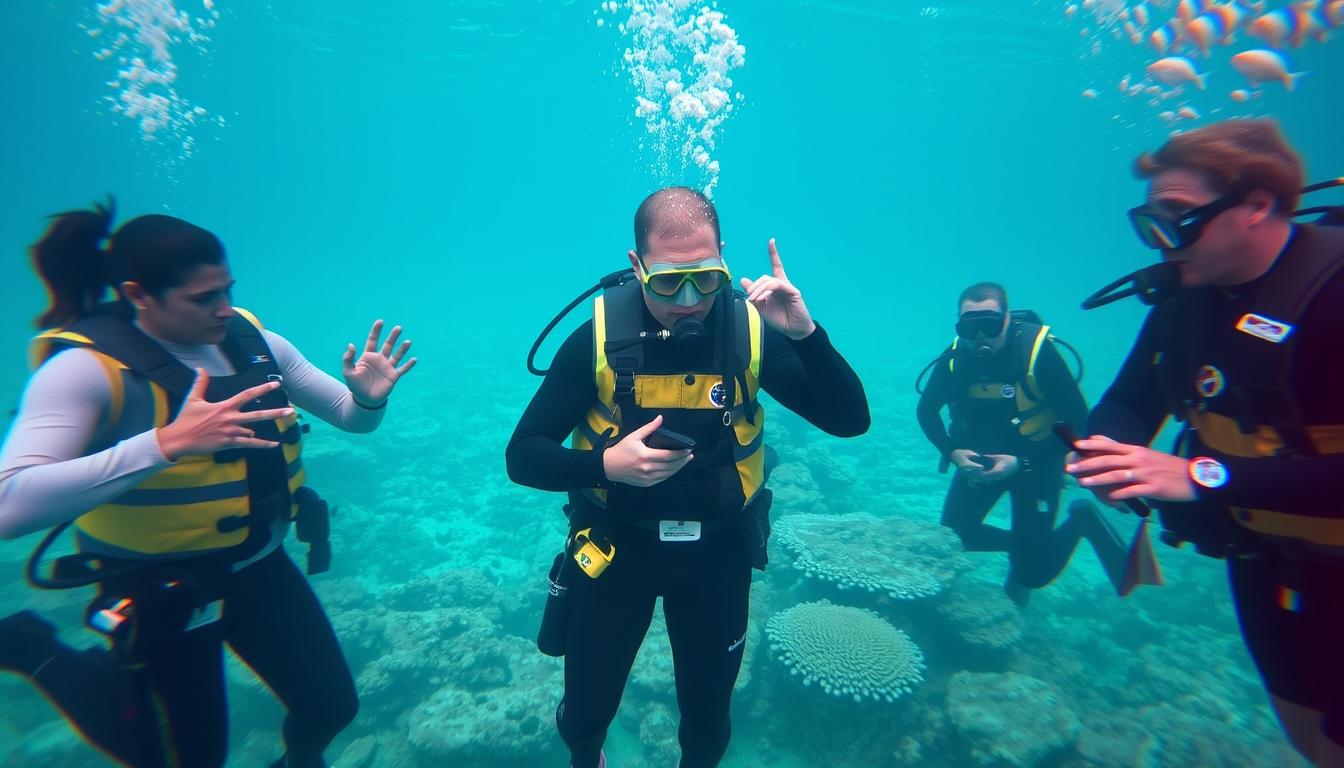
Before entering the water, introduce yourself to your dive buddy. Discuss experience levels and establish clear communication signals.
Effective dive planning follows the principle “Plan Your Dive, Dive Your Plan.” Determine maximum depth, bottom time, and turn-around points based on air consumption.
Equalization, Buoyancy, and Controlled Ascents
Proper equalization techniques prevent painful ear injuries during descent. Equalize frequently and never force pressure adjustment.
Mastering buoyancy control reduces air consumption and prevents accidental depth changes. Perfect buoyancy means hovering effortlessly at safety stop depth.
Controlled ascents are crucial for preventing decompression sickness. Maintain ascent rates of 9-18 meters per minute with mandatory safety stops.
| Practice | Key Benefit | Critical Metric |
|---|---|---|
| Buddy System | Immediate assistance availability | Pre-dive communication established |
| Dive Planning | Risk minimization | Maximum depth and time agreed |
| Buoyancy Control | Reduced air consumption | Hover at 5m with 50 bar remaining |
| Controlled Ascent | Decompression prevention | 9-18m/minute ascent rate |
These core practices form the foundation of responsible scuba diving. When mastered, they become automatic responses that enhance every aquatic adventure.
Essential Gear, Equipment, and Buddy Checks
The final moments before a dive require systematic verification of all scuba components. This process ensures every piece of equipment functions correctly for the planned aquatic activity.
Comprehensive Gear Inspection Techniques
Begin with the buddy check procedure. Partners should inspect each other’s scuba equipment using a standardized approach.
Check regulator systems first. Test both primary and secondary regulators for smooth airflow. Verify hose connections and purge button function.
Move to buoyancy control devices. Inflate and deflate the BCD to confirm proper operation. Ensure all straps and buckles are secure.
Inspect monitoring instruments next. Check the dive computer battery and display readability. Verify tank pressure gauges show accurate readings.
Examine personal gear thoroughly. Look for cracks in masks and fins. Test cutting tools and signaling devices for quick access.
After the dive, properly stow all equipment. This prevents trip hazards and protects your valuable gear from damage.
Expert Tips for Managing Dive Safety Under Pressure
The mental aspect of diving presents unique challenges that equipment alone cannot solve. Even skilled divers face psychological hurdles that impact their performance and security.
Experience can sometimes work against you. After approximately 50 dives, many individuals develop overconfidence that leads to skipped steps.
Avoiding Common Mistakes and Overconfidence
Justifying your maximum depth is crucial for risk management. If you cannot describe your purpose at 40 meters in one sentence, reconsider the dive plan.
Poor air consumption often stems from stress rather than lung capacity. Shallow breathing maintains high CO₂ levels and increases heart rate.
Focus on slow, complete exhalations to force relaxation. This simple technique dramatically improves gas efficiency.
Practical Techniques from Experienced Instructors
Professional divers develop habits that separate them from average participants. They check gauges every five minutes like glancing at a wristwatch.
Anticipatory buoyancy adjustments prevent constant depth changes. Add air in half-second pulses before sinking begins.
Proper horizontal trim reduces drag and conserves energy. Vertical positioning creates excessive resistance and burns air rapidly.
| Common Problem | Expert Solution | Key Benefit |
|---|---|---|
| Overconfidence after experience | Consistent pre-dive checks | Prevents complacency errors |
| Rapid air consumption | Slow, complete exhalations | Reduces stress and CO₂ buildup |
| Depth instability | Anticipatory BCD adjustments | Maintains neutral buoyancy |
| Inefficient movement | Horizontal trim positioning | Minimizes drag and effort |
| Poor navigation | Simultaneous time/compass checks | Accurate return positioning |
These practical tips from seasoned instructors highlight that small, consistent habits create the safest diving experiences. Mastering these techniques transforms how you approach each aquatic adventure.
Strategies for Dive Planning and Risk Management
Systematic dive planning transforms potential risks into manageable variables. This creates a predictable and secure experience for all participants. A thorough approach considers multiple factors before entering the water.
Every dive plan must address depth limits, bottom time, and environmental conditions. Establish clear entry and exit points with your buddy. Discuss potential hazards and agree on emergency procedures.
Utilizing Checklists and Pre-Dive Briefings
Professional divers rely on checklists to avoid missing critical steps. These tools cover equipment checks, communication signals, and contingency plans. Consistent use prevents complacency errors.
Pre-dive briefings provide essential site-specific information. Listen carefully to your guide regardless of experience level. The principle “Plan Your Dive, Dive Your Plan” remains fundamental to safe diving practices.
Always dive within your training and comfort zone. Honest self-assessment prevents pushing beyond safe limits. Evaluate your buddy’s capabilities to ensure effective assistance if needed.
| Planning Element | Key Consideration | Risk Reduction Benefit |
|---|---|---|
| Maximum Depth | Certification limits and gas planning | Prevents nitrogen narcosis and decompression issues |
| Bottom Time | Air consumption rate and no-decompression limits | Ensures adequate air supply and safe ascent profile |
| Environmental Conditions | Current strength, visibility, water temperature | Matches dive plan to actual operating environment |
| Buddy Capabilities | Training level, experience, physical condition | Ensures mutual assistance capacity |
| Abort Criteria | Pre-agreed conditions for ending dive early | Provides clear decision-making framework |
Conservative planning builds safety margins for changing conditions. Establish clear abort criteria before entering the water. This systematic approach makes every dive more enjoyable and secure.
Adapting to Changing Underwater Conditions
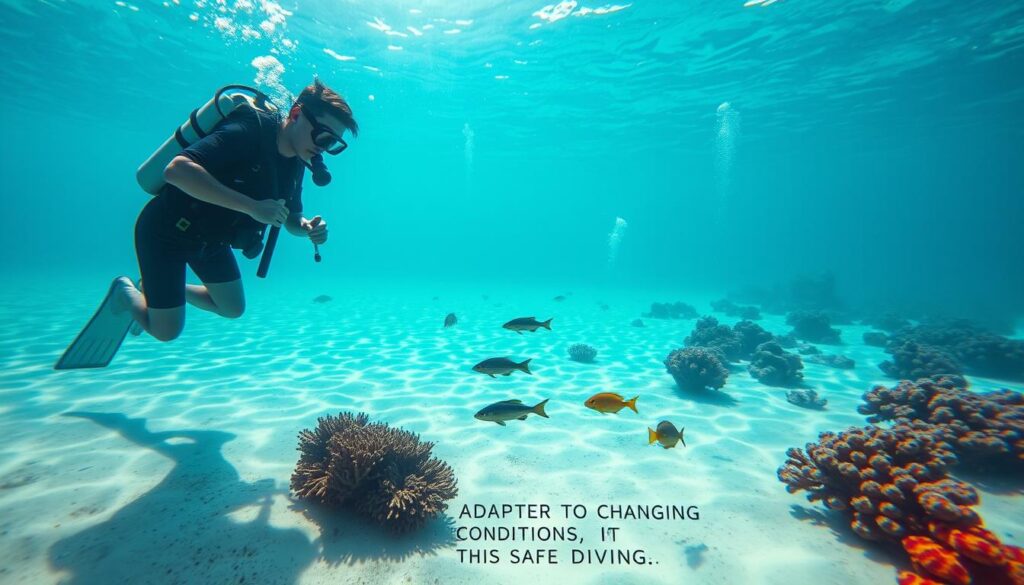
The aquatic environment is dynamic, requiring divers to constantly adapt their approach. Every dive presents unique challenges based on visibility, current, and marine life. Smart divers learn to work with these elements rather than fight them.
Handling Low Visibility, Currents, and Variable Conditions
Strong currents demand specific strategies. Stay low in the water column where friction reduces flow. Use the bottom as a visual reference. If you must move forward, swim at a diagonal angle to conserve energy and air.
Fighting the flow wastes air and leads to exhaustion. Let the current carry you when possible. This is a core skill for drift diving.
In low visibility, maintain close contact with your buddy. Swim slowly to avoid stirring up silt. Keep your dive light ready even during daytime dives.
Rely heavily on your instruments for depth and direction. Stay calm to prevent disorientation. Be prepared to end the dive if visibility becomes unsafe.
When encountering large marine life, maintain a respectful distance. Control your buoyancy precisely. Avoid rapid movements that could startle animals.
If you feel unwell during a dive, communicate immediately with your buddy. Consider an early termination. Your health is the top priority.
Should you lose sight of your partner, search for one minute. Then make a slow, controlled ascent to the surface. Your buddy should do the same for a safe reunion.
| Condition | Key Strategy | Primary Goal |
|---|---|---|
| Strong Current | Stay low, use diagonal movement | Conserve energy and air supply |
| Low Visibility | Close buddy contact, slow pace | Maintain orientation and communication |
| Large Marine Life | Maintain distance, control buoyancy | Respectful observation without disturbance |
| Buddy Separation | One-minute search, controlled ascent | Safe surface reunion |
Conclusion
The difference between routine dives and extraordinary underwater experiences often lies in disciplined adherence to core protocols. These fundamental rules create the foundation for lifelong enjoyment of scuba diving.
Remember to never hold your breath during ascent. Always ascend slowly and complete mandatory safety stops. This prevents decompression sickness and gives nitrogen a chance to dissipate safely.
Dive within your personal limits and training. Use your dive computer to monitor depth and time. Proper weight and buoyancy control are essential for every diver.
By consistently applying these safety measures, you maximize your chance of enjoying thousands of incident-free dives. The ocean awaits those who respect its power while embracing its wonders.